
- The Tragedies - The Comedies - The Histories - The Sonnets
- The Life of Shakespeare - The Times of William Shakespeare - The Characters from Shakespeare - Stories and Plots
- Shakespeare Quotes - Doubtful Works - Site Map - More ...
Romeo and Juliet
History of Romeo and JulietThe story originates from a 1476 story of Mariotto and Gianozza by MasuccioSalernitano, in Il Novelino. Luigi da Porto's Istoria novellamenteritrovata di due Nobili Amanti gave the story much of itsmodern form, renaming the lovers to Romeus and Giulietta andshifting the action from Siena to Verona. Da Porto's story was taken up and included byMatteo Bandello in his Novelle of 1554, and versified by Arthur Brooke, whosenarrative poem "Tragicall Historye of Romeus and Juliet", writtenin 1562, was the source forShakespeare's Romeo and Juliet. Shakespeare enriched itstexture through his vivid characterizations of both major and minorcharacters, in particular the Nurse and Mercutio. Romeo and Juliet - The StoryThe play begins with a prologue in the form of a sonnet. The speaker explains tothe audience that the story concerns two warring families inVerona, Italy, and how the feud betweenthem is ended in a manner which neither side could have wanted orexpected. The action proper starts with a typical street-brawl between thetwo families, Montague and Capulet, started by their servants andput down by the Prince of Verona. He fines the heads of bothfamilies and declares severe penalties, including death, for thosewho disturb the peace again. Paris, a nobleman, talks to old Capulet about marrying histhirteen-year-old daughter Juliet. The Capulet demurs, citing thegirl's young age: "My child is yet a stranger in the world; Shehath not seen the change of fourteen years." Paris persists,arguing "Younger than she are happy mothers made." The Capulet askshim to attract the attention of Juliet during a masquerade ballthat the family is to hold a day later. Meanwhile Juliet's mothertries to persuade her young daughter to accept Paris's wooingduring their coming ball. The question of Juliet's age is againraised, as her mother, echoing Paris, declares, "younger than you /Here in Verona, ladies of esteem / Are made already mothers."Juliet does not want Paris, but, being a dutiful daughter, accedesto her mother's wishes. This scene also introduces Juliet's nurse,the comic relief of the play, who recounts a bawdy anecdote aboutJuliet, punctuated with religious ejaculations. In the meantime, old Montague and his wife fret to their nephewBenvolio about their son Romeo, who has long been moping forreasons unknown to them. Benvolio promises Montague that he willtry to determine the cause. Benvolio queries Romeo and finds thathis melancholy has its roots in his unrequited love for oldCapulet's niece, a girl named Rosaline. Benvolio tries to snapRomeo out of his funk, to no avail: despite the good-natured tauntsof his fellows, including the witty nobleman Mercutio, Romeoresolves to attend the masque at the Capulet house, relying on notbeing spotted in his costume, in the hopes of meeting up withRosaline. Romeo attends the ball as planned, but he does not see Rosalineand falls instead for Juliet. Tybalt, Juliet's hot-blooded cousin,recognizes Romeo under his disguise and calls for his sword. OldCapulet, however, speaks kindly of Romeo and, having resolved thathis family will not be first to violate the Prince's decree,sternly forbids Tybalt from confronting Romeo. Tybalt stalks off ina huff. But, soft! what light through yonder window breaks? Romeo and Juliet essay topicsEmboldened, Romeo risks his life by remaining on the Capuletestate after the party breaks up, to catch another glimpse ofJuliet at her room, and in the famous balcony scene, the twoeloquently declare their love for each other. The young loversdecide to marry without informing their parents, because they wouldundoubtedly disallow it due to the planned union between Paris andJuliet. With the help of Juliet's Nurse and the Franciscan priest FriarLawrence, the two are wedded days later. Friar Lawrence performsthe ceremony, hoping to bring the two families to peace with eachother through their mutual union. Things take a darker turn in the next Act. Tybalt, stillsmarting from the incident at the Capulets' ball, meets up withRomeo and attempts to provoke a fight. Romeo refuses to fightTybalt because they are now kinsmen - although Tybalt doesn't knowit. Mercutio, who is also unaware of the marriage, is incensed byTybalt's actions and takes up the challenge himself. In the ensuingswordplay Mercutio is fatally wounded by Tybalt and Romeo, in hisanger, kills Tybalt. Although under the Prince of Verona's priorproclamation Romeo would be subject to the death penalty, thePrince reduces Romeo's punishment to exile in light of the factthat Tybalt had killed Mercutio, who was not only Romeo's friendbut a relative of the Prince. Romeo flees to Mantua. Juliet is extremely grieved when she hears this, and when sherealizes that her father will force her to go through with themarriage to Paris, she seeks the help of Friar Lawrence once more.Friar Lawrence, an expert in herbal medicines and potions, givesJuliet a potion and a plan: the potion will put her in a death-likecoma for two days; she is to take it before her marriage day, andwhen discovered dead, she will be laid in the family crypt.Meanwhile, the Friar will send a messenger to inform Romeo so thathe can rejoin her when she awakes. The two can then leave forMantua and live happily ever after. Juliet takes the potion, and things proceed as planned.Unfortunately, the Friar's messenger is unable to reach Romeo dueto Mantua being under quarantine, and Romeo learns only of Juliet'ssupposed "death" through a family servant. Grief-stricken, he buyssome strong poison, returns to Verona in secret, and proceeds tothe Capulets' crypt, determined to join Juliet in death. Uponarrival he encounters Paris, who has also come to mourn privatelyfor his lost love. After killing Paris in a duel, Romeo drinks thepoison after seeing Juliet one last time. Seconds later Julietawakens and sees Romeo dead. Juliet cannot imagine a rewarding lifewithout Romeo and so she stabs herself fatally with his dagger. Thetwo lovers lie dead by each other's sides, madly in love anddevoted until the last breath of life. All three are found dead shortly thereafter by a squire, whoruns off to alert others. As word spreads throughout Verona aboutthe deaths, the two feuding families meet at the tomb with thePrince. They are horrified to find Romeo, Juliet, and Paris alllying dead, and Friar Lawrence, who has hurried to the crypt but istoo late to prevent the tragedy, reveals to them the love andsecret marriage of Romeo and Juliet. The feuding families arereconciled by their children's deaths and agree to end theirviolent feud, as explained by the prologue. Romeo and Juliet shakespeareIn common with many of Shakespeare's plays, the majority ofRomeo and Juliet is written in iambicpentameter. However, the play is also notable for its heavy useof rhymed verse, especiallyin the sonnet containedin Romeo and Juliet's dialogue in the scene where they first meet.This sonnet figures Romeo as a pilgrim (palmer) praying before animage of the Virgin Mary, as many persons inearly-sixteenth-century England did at shrines such as the shrineof Our Lady ofWalsingham.[1](http://www.galbithink.org/sense-s5.htm) Because ofits use of rhyme, its extravagant expressions of love, and itsimplausible plot, Romeo and Juliet is considered to belongto Shakespeare's "lyricalperiod", along with the similarly poetic plays A Midsummer Night's Dream andRichard II. Romeo and Juliet is one of the earlier works in theShakespearean canon, and while it is often classified as a tragedy, it does not bear thehallmarks of the 'great tragedies' like Hamlet and Macbeth. Some argue that Romeo and Juliet's demisedoes not stem from their own individual flaws, but from the actionsof others or from accidents. Unlike the great tragedies, Romeoand Juliet is more a tragedy of mistiming and ill fate.However, others consider rashness and youth to be the tragic flaws of Romeoand Juliet. It has been noted that the plot of Romeo and Juliet ismore that of a farce orcomedy oferrors than a tragedy, except that it lacks the vitallast-minute save and everyone dies at the end instead of livinghappily ever after. However, it can also be argued that not all iswoe at the end. A long-running feud is ended, although at the priceof the two lovers' lives, thus, no doubt, future deaths have beenprevented. The play satirizes Italy in Shakespeare's time, attacking theCatholicChurch (largely to please QueenElizabeth) and, by making Romeo marry a girl who was seen asscandalously young, making a form of the modern redneck joke. Adaptations of Romeo and JulietThere have been quite a few adaptations of Romeo and Juliet,created for many media. PlaysOther versions of Shakespeare's Romeo and Juliet play had been made, whichhad the "culture" of where the play was made as the "setting". Forinstance, a version of the play which had Romeo as a Palestinian and Julietas a Jew in Israel and the Palestinian territories was made,which criticizes the Israeli-Palestinianconflict.
OperaThe story was converted into the opera Roméo etJuliette by Charles François Gounod in 1867 with a libretto written by Jules Barbier and Michel Carré. The Romeo and Juliet story was also the subject of VincenzoBellini's opera I Capuleti e iMontecchi, although Bellini and his librettist, Felice Romani,worked from Italian sources, and these were only distantly relatedto Shakespeare's work. Romeo and Juliet as a BalletSeveral balletadaptations of the story have been made, the first written in the18th century. The best known feature music by SergeiProkofiev, and a variety of choreographers have used thismusic. The first version featuring Prokofiev's music was performedin 1938. See: Romeo and Juliet (Prokofiev) [edit] MusicalThe musicalWestSide Story, also made into a film, is based on Romeo andJuliet but updates the story to mid-20th century New York City andthe warring families to ethnic gangs. Roméoet Juliette, de la Haine à l'Amour, a musical by Gérard Presgurvic, premiered onJanuary 19, 2001 in Paris, France. The song "Exit Music (For a Film)" by Radiohead was made for the1996 movie version (seebelow) of Romeo and Juliet and is sung from the point ofview of someone waking up his lover and inviting them to join themin escaping from the oppression of their respective familiesthrough suicide. [edit] Instrumental MusicAmong the instrumental pieces inspired by the play are Tchaikovsky's Romeo and Juliet, FantastyOverture after Shakespeare and Hector Berlioz'sRoméo et Juliette "Symphoniedramatique", although the latter does have substantial vocalparts. Prokofiev also created three orchestra suites and a pianosuite, Romeo and Juliet: Ten Pieces forPiano, based on the music from his ballet. [edit] Movie versionsThere have been over forty movie versions of the tale, with thefirst in 1900. Some of themore notable adaptations include:
[edit]
Retrieved from "http://en.wikipedia.org/wiki/William_Shakespeare" All text is availableunder the terms of the GNU Free Documentation License |
All Shakespeare | |||||||||||
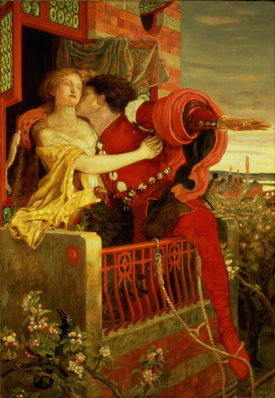 Romeo and Juliet by Ford Madox Brown
![[advertisement]](ban10.gif)