
- The Tragedies - The Comedies - The Histories - The Sonnets
- The Life of Shakespeare - The Times of William Shakespeare - The Characters from Shakespeare - Stories and Plots
- Shakespeare Quotes - Doubtful Works - Site Map - More ...
Macbeth
On the stage, Lady Macbeth is seen by manyas one of the most challenging roles in Western theater for women.She is driven mad for her part in the king's crimes and dies offstage in the final act. The play is one of Shakespeare's most popular works—aswell as his shortest tragedy—and is frequently performed atprofessional and community theatres around the world. It is seen asan archetypal tale of dangers of the lust for power and betrayal offriends. Shakespeare's Macbeth SynopsisThe play opens with three bearded witches discussing when theywill again meet. They say: "Where the place? / upon the heath./There to meet with Macbeth" They decide to meet Macbeth and thismeeting is what sends him down a path of destruction. Macbeth, Thane ofGlamis and a general ofthe army of Duncan, King of Scotland, has gained great renown afterdefeating an invasion by the forces of Norway and Ireland, led by the rebel Macdonwald. Duncan grantsMacbeth the title of Thane of Cawdor and the honor of an official visit to Macbeth'shome at Inverness. At this time, Macbeth and his friend Banquo are wandering alonga heath, where they meet three Witches. The first witch greets Macbeth as "Thane of Glamis," the second as "Thane of Cawdor," and the third tells him that he shall "beKing hereafter." The Witches also inform Banquo: "Thou shalt get[beget] kings, though thou be none." Macbeth is confused at beingcalled "Thane of Cawdor," until the messenger arrives and tellsMacbeth of his new title. Immediately, Macbeth wonders whether theWitches were also correct in predicting that he would becomeking. Macbeth writes about the witches' prophecies in a letter to hiswife (referred to only as "Lady Macbeth"). She immediately resolvesthat her husband will be king, and, moreover, will do it by killingDuncan. As luck would have it, Duncan is coming to stay in theMacbeths' castle that very night. In the dead of night, Macbeth and his Lady kill Duncan andarrange the bloody daggers to make it look like two servantscommitted the murder. After the murder, Macbeth hears a voiceinside his head, proclaiming "Sleep no more... Glamis hath murder'dsleep, and therefore Cawdor / Shall sleep no more; Macbeth shallsleep no more." Duncan's body is discovered by Macduff, another lord, who isimmediately suspicious of Macbeth. However, Macbeth kills the twoservants who ostensibly committed the crime (so they won't talk),and insinuates that Duncan's sons, Malcolm and Donalbain, committedthe murder. The rightful heir, Malcolm, along with his brotherDonalbain, flee to England, where they are joined by Macduff,the loyal Thane of Fife.Macbeth is proclaimed king. Macbeth is still uneasy, though. He is apparently childless(although Lady Macbeth claims to have nursed a baby: "I have givensuck") and worries about the Witches' prophecy that Banquo would bethe father of kings. Macbeth's friend Banquo, who, the witches have predicted, will "getkings, though [he] be none," (that is, be progenitor of the kingsof Scotland, thereby jeopardizing Macbeth's rule) begins to suspectMacbeth. Macbeth, becoming more paranoid, evil, and suffering frominsomnia, ordersBanquo's murder in order to prevent the prediction from comingtrue. That night, at the royal banquet, Banquo's ghost enters andsits in Macbeth's place. Macbeth is the only person who can see theghost, and frightens his guests with his display of terror andguilt. Macbeth goes to the Witches again and receives three moreprophecies. Urged on by Macbeth, the witches conjure spirits whichtell him that he will not "vanquish'd be until Great Birnam wood tohigh Dunsinane Hill shall come against him" andthat "none of woman born shall harm Macbeth," but also to "fearMacduff". Since Macduff is in exile, Macbeth orders the murder ofhis wife and children. The stabbing of Macduff's childish son bythe nameless "first murderer" is graphically depicted onstage. In England, Malcolm and Macduff lament Macbeth's seizing ofpower, and lay plans for an invasion of Scotland. Lady Macbeth eventually goes mad with guilt for the crimes shehas committed. In a famous scene, she sleepwalks and tries to washimaginary bloodstains off her hands. She eventually dies, whichcauses Macbeth to ruminate on the futility of life. Macduff, spurred into seeking revenge, cries "Bring thou thisfiend of Scotland and myself / Within my sword's length set him; ifhe 'scape / Heaven forgive him..." and leads a camouflaged army withMalcolm and the English Earl of Siward (the Elder) againstDunsinane castle. Macbeth delivers a nihilistic soliloquy upon learning of Lady Macbeth's death(the text does not explain how she died) but is interrupted by amessenger declaring that he "look'd toward Birnam, and anon,methought / The wood began to move....Within this three mile mayyou see it coming;/ I say, a moving grove." A furious Macbethresponds in typical form: "At least we'll die with harness on ourback." Meanwhile, the army is advancing on the castle. Malcolmappoints Siward and Macduff to lead the assault. A battle ensues, culminating in Macduff's confrontation ofMacbeth. Macbeth boasts that he has no reason to fear Macduff, ashe cannot be killed by any man born of woman. Macduff declares thathe "was from his mother's womb / Untimely ripp'd"—that is,born by Caesarean section or its medievalequivalent —and was therefore was not "of woman born." Thetwo fight, ending with Macduff beheading Macbeth offstage, therebyfulfilling the last of the witches' prophecies. In the final scene of the play, Malcolm promises to be crownedas rightful king of Scotland, and peace is restored to thekingdom. Shakespeare's Macbeth Recurring motifsMacbeth's visions. Macbeth sees an imaginary bloody knifein the air pointing to King Duncan’s resting chamber“Is this not a dagger which I see before me, the hand towardmy hand” (Act II Scene I). Macbeth knows what he is doingwill change his life. Committing regicide is a sin that can’tbe forgiven. Macbeth may see this through the supernatural powersof the three witches, or it may be another hallucination. LadyMacbeth believes there is blood on her hands that won’t comeoff “Out damned spot! Out I say!” (Act 5 Scene 1). LadyMacbeth here is sleepwalking and spot is being referred to as bloodstained hands. Lady Macbeth can’t cleanse herself of theguilt of plotting King Duncan’s murder. Blood and bloodshed. At the beginning of the play,Macbeth’s army has just defeated Norwegian invaders in agruesome battle. A captain is mortally wounded and the king remarkson it, “What bloody man is that? He can report, as seemeth byhis plight” (Act I Scene II). The shedding of blood continuesthroughout the play until the very end when Macbeth is slain byMacduff “Hail King! For so thou art: behold, where standsTh’ usurpers cursed head”. Macduff then shows Malcolm,the new king, Macbeth’s head dripping with blood. Blood canalso be shown as representing guilt. When Macbeth kills King Duncanblood on his hand symbolizes guilt. Later in the play, Lady Macbethbelieves that she sees blood on her hands. Macbeth is seen as warning of the dangers of ambition,showing that ambition can be a morally corrupting agent. Shakespeare's Macbeth Shakespeare's sources
Shakespeare's Macbeth Film versions
Shakespeare's Macbeth Adaptations
Retrieved from "http://en.wikipedia.org/wiki/William_Shakespeare" All text is availableunder the terms of the GNU Free Documentation License |
All Shakespeare |
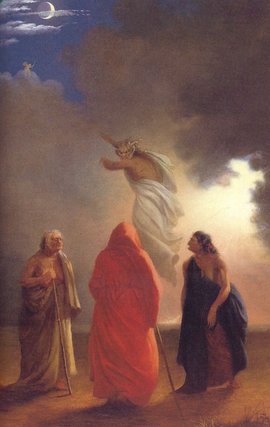 Scene from Macbeth by William Rimmer, depicting the witches'conjuring of an apparition in Act IV, Scene I
![[advertisement]](ban10.gif)
Our Sponsors
-
- Study Guide - About Us- Privacy Policy - Site Map - Other Languages - Links - Link Exchange - More ...